

Rematrix joins the European Outdoor Group as the first EPR- Producer Responsibility Organization r to become a member of the association, bringing industrial circularity to European Outdoor Week and ORBDAYS 2026. From the panel discussion with Reju and Peak Performance to the “Repair & Regenerate” initiative with Patagonia: how the outdoor textile supply chain is transforming from theory into a concrete industrial system.
Rematrix’s entry intothe European Outdoor Group (EOG)—the association that brings together the leading players in the European outdoor industry—represents an important strategic step in the development of Producer Responsibility Organization. Rematrix is, in fact, the first EPR- Producer Responsibility Organization r to join the organization, a move that confirms its commitment to an industry characterized by high-performance products, transparency toward consumers, and responsibility toward society and the environment.
Joining EOG means contributing directly to the creation of a European ecosystem that is increasingly focused on sustainability, extended producer responsibility, and the development of circular industrial supply chains, in which environmental value is integrated with economic and social value.
Today, the textile and outdoor industry faces a real challenge: developing models capable of managing end-of-life products in an efficient, traceable, and scalable manner. For this reason, it is essential to forge strong connections between brands, collection systems, recovery operators, and the recycling industry.
European Outdoor Week & ORBDAYS 2026: From Vision to Action
This vision was put into practice duringEuropean Outdoor Week and ORBDAYS 2026, which transformed Riva del Garda into the hub of the European outdoor industry.
For Rematrix, the event represented an important opportunity to engage with companies, brands, and operators committed to transforming the textile and outdoor supply chain. A shared conviction emerged at the heart of the discussion: circularity can only work when it becomes a structured industrial system, based on collaboration among supply chain stakeholders, dedicated infrastructure, and concrete operational solutions.
Through meetings, new partnerships, and on-the-ground initiatives, Rematrix has actively contributed to the discussion on the future of the European textile supply chain, drawing on its experience in managing post-consumer waste streams and developing EPR systems.
From Theory to an Industrial Circular Textile System
During the Outdoor Impact Summit, Rematrix participated in the panel discussion “Closing the Loop: How Collection, Recycling, and Brands Create Sustainable Circular Opportunities” alongside Reju and Peak Performance.
The discussion addressed one of the most important issues for the sector: how to transform circularity from a theoretical concept into a concrete industrial model.
In recent years, the debate has focused primarily on the goals of the circular transition. Today, however, the real challenge lies in creating systems capable of generating industrial value, ensuring continuity in material flows, and reducing dependence on virgin resources.
In this context, Rematrix has highlighted how Extended Producer Responsibility (EPR) systems can evolve from simple compliance tools into full-fledged industrial coordination infrastructures, capable of enabling stable, qualified, and traceable post-consumer waste streams.
Reju emphasized the need to develop a European capacity to recycle polyester from post-consumer textile waste, thereby reducing dependence on virgin raw materials and global supply chains.
The discussion revealed a shared vision: sustainability can no longer be addressed solely as a regulatory or reputational issue, but must become a strategic lever for European industrial competitiveness.
As noted during the panel discussion:
“Circularityis no longer just an environmental driver, but a concrete opportunity to create industrial value for Europe.”
From Collection to Regeneration: Concrete Examples of a Circular Supply Chain
This theory was put into practice within the exhibition space as well as through the initiatives organized during ORBDAYS.
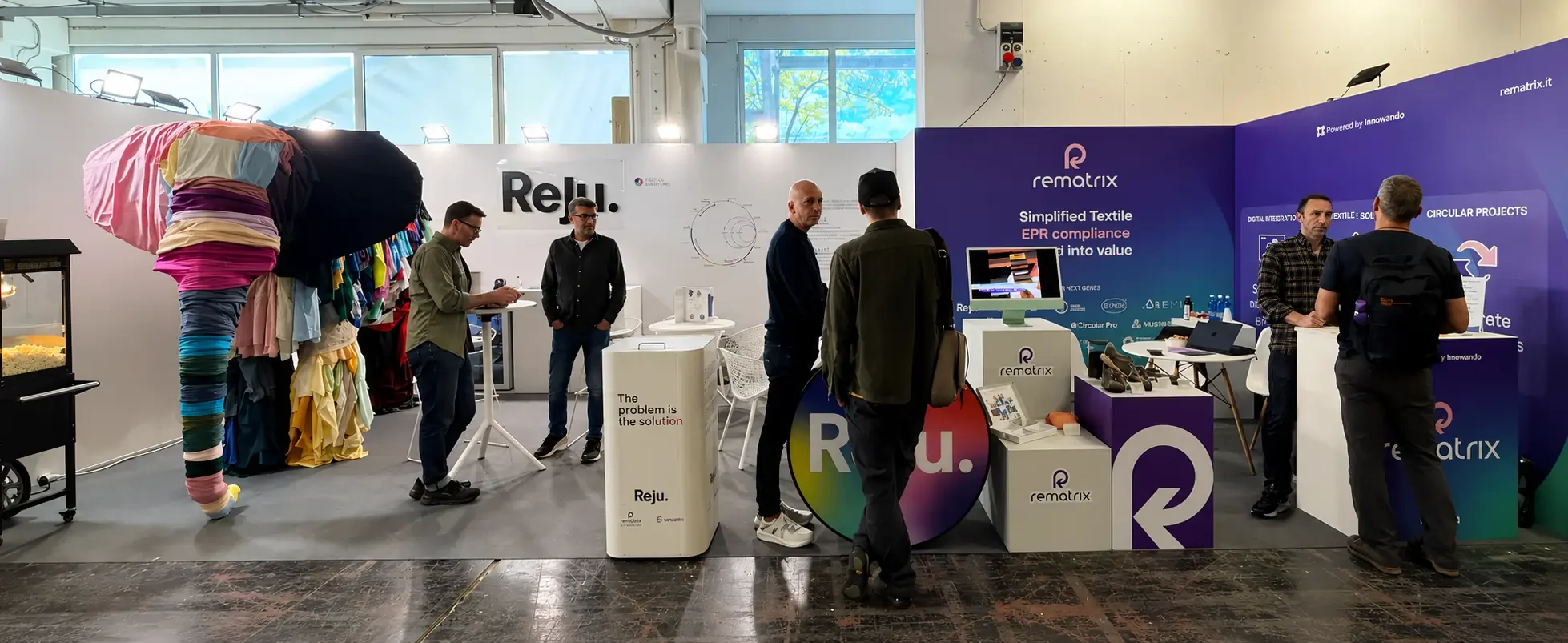
Rematrix and Reju presented a concrete example of a circular supply chain, illustrating the various stages of the process by which an end-of-life textile product is transformed into a new raw material. From the collection of garments to sorting, and on to the recycling and regeneration processes, the system was made transparent, traceable, and understandable for companies and participants.
Rematrix outlined its role in managing and coordinating post-consumer waste streams, helping brands adapt to future European EPR systems, while Reju showcased its chemical recycling technologies, which can transform post-consumer textile waste into regenerated polyester and enable a true textile-to-textile model on an industrial scale.
Repair & Regenerate: The Partnership with Reju and Patagonia
During ORBDAYS, Rematrix also participated in the “Repair & Regenerate” initiative alongside Reju and Patagonia, providing a concrete example of collaboration across the entire value chain.
The initiative arose from the realization that every year, enormous amounts of resources are used to produce clothing, while only a small fraction of the materials is actually recovered and recycled.
Patagonia collected damaged outdoor clothing and products, prioritizing repair as the first step to extend their useful life. When reuse was no longer possible, Rematrix and Reju stepped in to ensure proper end-of-life management and to channel the materials into textile-to-textile recycling processes.
At the same time, during the event, Rematrix and Reju organized a used clothing drive, directly involving participants in the circular economy. The collected items were sent for reuse or recycling based on their condition, ensuring full traceability of the material flows and the recovery of raw materials.
These initiatives have demonstrated how collaboration between brands, EPR systems, and the recycling industry can already generate concrete, replicable solutions capable of making a real impact.
Toward a New European Industrial Model
The experiences shared during European Outdoor Week and ORBDAYS have shown how a supply chain that is still fragmented can evolve into an integrated industrial ecosystem, in which collection, sorting, recovery, and recycling operate in a coordinated manner.
In this context, future European regulations—in particular EPR systems—are not merely a compliance requirement, but a strategic tool for fostering innovation, investment, and industrial competitiveness.
The challenge in the coming years will no longer be to envision circularity, but to build the infrastructure, partnerships, and processes needed to make it scalable.
And it is precisely in this area that Rematrix intends to continue contributing to the development of a European textile system that is increasingly circular, efficient, and focused on creating value.