

Regulations onthe Extended ProducerResponsibility (
)
for 2026
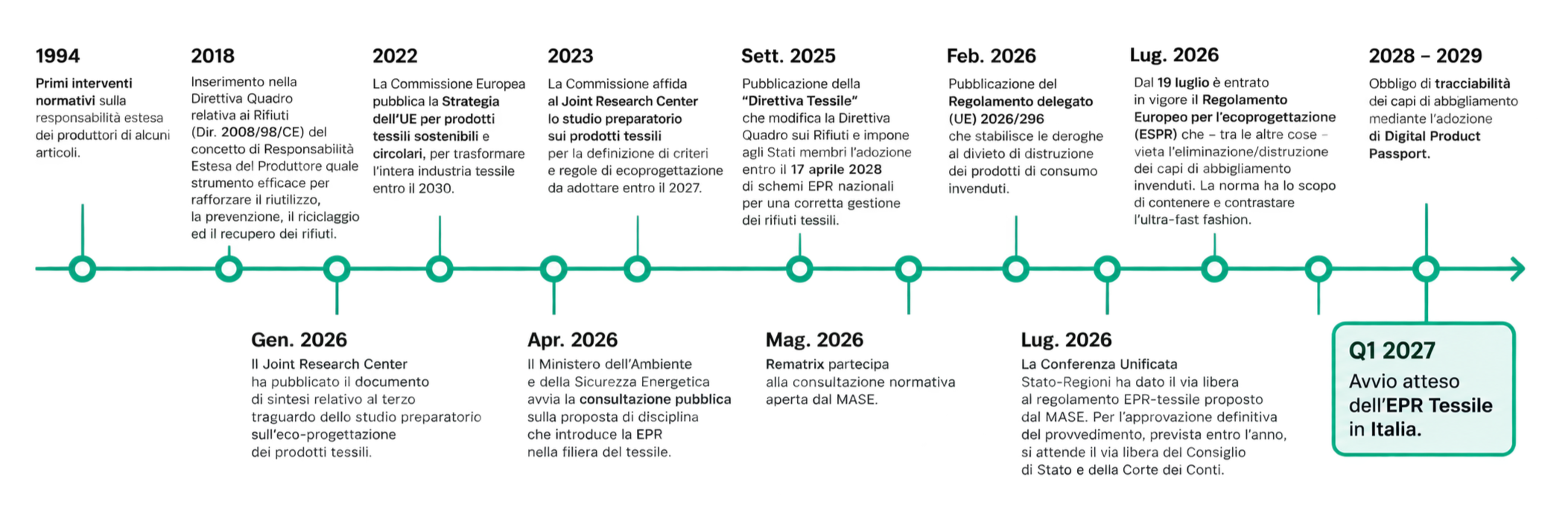
Extended Producer Responsibility (EPR) is an environmental policy established by the European Union under which the manufacturer of a product is also held responsible for the post-consumer phase and, therefore, for its management once it becomes waste.
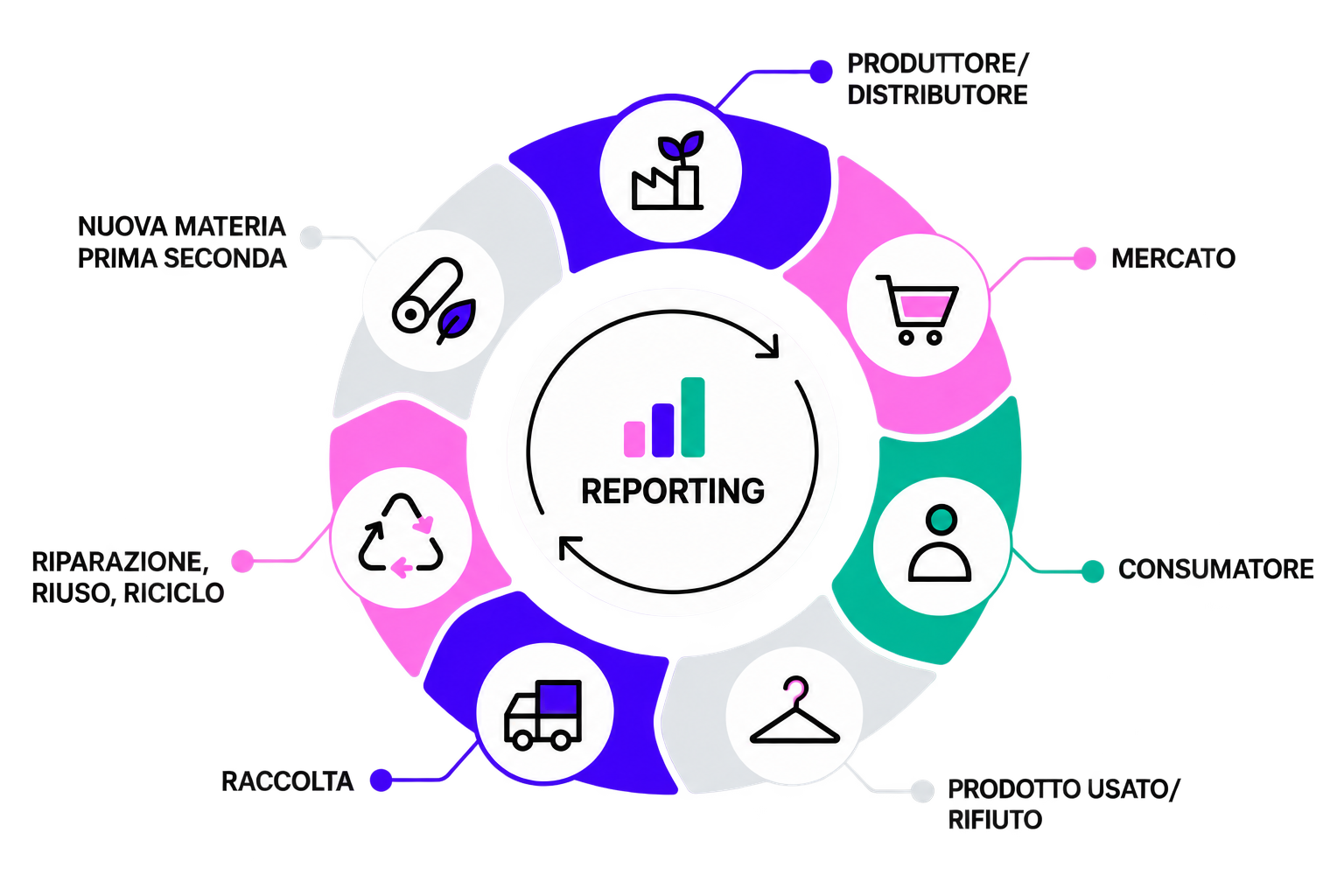
EPR circularity at a glance
What is the goal?
The goal of the draft decree is to ensure the proper management of end-of-life textile products, promoting their reuse and recycling and encouraging
eco-design by manufacturers.
The textile industry is, in fact, particularly polluting in terms of CO2 emissions, water use, and water pollution during production and consumption. Taking action on post-consumer waste and holding textile manufacturers accountable aims to reduce the consumption of new raw materials and limit the overproduction typical of the new fast and ultra-fast fashion models.
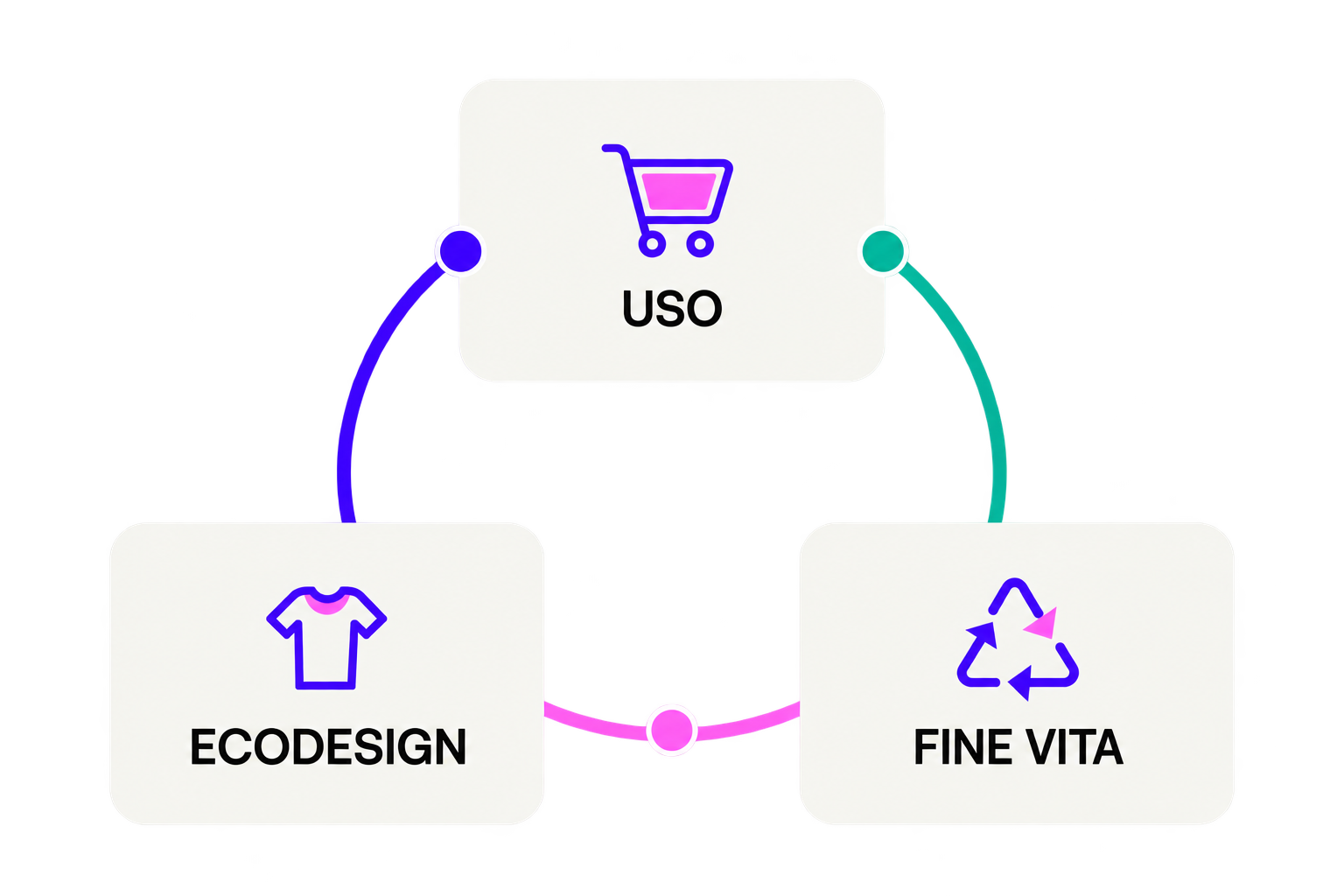
In this scenario, the EPR framework complements
eco-design policies.
What does the draft
Italian decree?
Any entity that first places textile products, footwear or accessories on the domestic market ("manufacturer") shall ensure and support the following points:
01

Registration and membership in a
management system
Registration in the National Register of Producers is required
Participation in a system (Producer Responsibility Organization , or individual program) recognized by MASE.
02

Environmental contribution
and transparency
Calculation and payment of the environmental fee (eco-modulated) based on the volume placed on the market.
It is mandatory to indicate this on the invoice if the product is resold and to ensure its traceability all the way to the end user.

03
Collection and extended responsibility
post-consumer
Contribute to achieving the minimum recycling collection goals (a management target adjusted over time).
Support the collection effort through retail locations and supply chain partners as well.
04

Eco-design and sustainability
of the product
Adoption of sustainable design criteria
(durability, recyclability, recycled content).Compliance with EU Ecodesign Regulation 2024/1781.
Eco-modulation: lower costs for manufacturers who use recycled materials and follow the principles of eco-friendly design
05

Reporting, Traceability
and digital passport
Transmission of data on products, materials, and flows.
Implementation of traceability systems and, where required, the digital product passport.
06

Investment in R&D, communication and outreach
Funding for research, development
, and innovation in the recycling industry.Public disclosure and consumer awareness and education
.
What Will Change
for businesses

Manufacturers of clothing, footwear, accessories, leather goods and home textiles will be responsible for collecting and processing post-consumer textiles throughout the country. They will have to organize themselves into individual or collective systems to comply with the regulations, invest in research for sustainability, adopt sustainable business models, and pay an environmental contribution proportional to the amount placed on the Italian market.
Operational complexity will lead many companies to consociative choice through a PRO (Producer Responsibility Organization) i.e., an organization, such as Rematrix, that manages Extended Producer Responsibility obligations
An Overview of All EPR Requirements

FAQ
-
Entities that place textile products on the Italian market for the first time must comply with the textile EPR regulations, regardless of the size of the company.
Specifically:
If a foreign manufacturer sells to an Italian importer, distributor, or retailer, the EPR obligation falls on the latter, as the first party to place the product on the market and invoice for it in Italy;
If a foreign manufacturer sells directly to Italian consumers (e.g., B2C e-commerce), the EPR obligation remains with the foreign manufacturer;
Manufacturers and brands based in Italy that sell private-label textile products in Italy are subject to EPR.
The following are excluded:
component suppliers (e.g., buttons, zippers);
manufacturers of semi-finished products (e.g., yarns, fabrics);
contract manufacturers who produce exclusively for third parties without placing finished products on the market under their own brand.
-
Although the Italian textile EPR decree is still pending approval (expected by the end of March 2026), based on the EPR schemes already in place in Italy (WEEE, fleece, packaging), it is reasonable to expect a structured penalty system.
Specifically, as a general guide and by analogy, administrative penalties for failure to comply with EPR obligations could include:
Failure to register with the national registry: from approximately €30,000 to €100,000
Failure to report data to the registry or reporting inaccurate data: from approximately €2,000 to €20,000
Failure to join a recognized collective system (PRO): from approximately €8,000 to €45,000
The EPR decrees currently in effect in other sectors also provide for mechanisms to mitigate penalties in cases of voluntary compliance or timely rectification, which could also be included in the final textile decree
-
The textile EPR is expected to take effect in Italy in 2026, tentatively in the first quarter, subject to the publication of the implementing decree. This has been publicly confirmed by official sources at MASE.
Meanwhile, at the European level, the framework legislation calls for the introduction of EPR schemes for textiles in all Member States, with varying transposition deadlines. Italy has expressed its intention to implement the system ahead of the European deadlines, making it operational as early as 2026.
The decree may also provide for transitional arrangements or different timelines, particularly for microenterprises, which could benefit from an additional adjustment period.
-
The environmental fee (eco-fee) is calculated based on the quantity of textile products placed on the Italian market during the calendar year.
The amount will be eco-adjusted, meaning it will vary based on environmental criteria, such as:
use of recycled materials,
eco-design and durability solutions,
environmental impacts of the product throughout its life cycle, with possible reductions for more sustainable products and surcharges for those with poorer performance.
It is reasonable to expect that manufacturers will be required to report annually, by deadlines to be established by the decree, the quantities and categories of products placed on the market during the reference year and, in accordance with procedures that may be established, also a forecast for the following period.
The total amount of the eco-contribution is determined in such a way as to enable the EPR system to meet the collection, reuse, and recycling targets set by law for the following year.
The eco-fee is paid by the manufacturer through the “ Producer Responsibility Organization ” or the collective system to which it belongs. Whether or not the fee is shown in the price or on the invoice to end-users or business customers remains a commercial decision by the manufacturer, unless otherwise specified in the implementing decree.
-
In the context of textile EPR, “eco-design” refers to the design of products that takes into account their environmental impacts throughout their life cycle, starting from the development phase.
Although it is not a direct requirement of EPR, eco-design is strongly encouraged and may involve, for example:
the durability of the products,
the ease of recycling at the end of its life,
the use of recycled materials or materials with a lower environmental impact.
These principles are consistent with the European Ecodesign Regulation (ESPR) and are expected to become increasingly relevant for the purposes of eco-modulation of the EPR contribution, which may reward products designed in a more sustainable manner.
In this sense, EPR and Ecodesign are complementary tools designed to promote the reuse and recycling of textile materials, reduce the use of virgin raw materials, and support the transition to a circular economy model.
-
For 2026, the draft Italian textile EPR legislation calls for the introduction of initial separate collection targets, which serve as the starting point for a path of gradual growth in subsequent years. The drafts mention targets that will increase from 20% of the amount placed on the market.
The specific percentages and the methods for calculating the targets will be defined in the implementing decree, in line with the European framework and with developments in collection systems throughout the country.
These targets will be achieved through consortia and collective systems, which will organize and finance the collection of textile waste through various channels, such as collection points, agreements with supply chain operators, and dedicated logistics systems.
-
The draft textile EPR regulation does not provide for an exemption for microenterprises, but it may introduce transitional measures or different timelines to facilitate their compliance.
In line with other EPR schemes, microenterprises (fewer than 10 employees, as defined by the EU) may be granted an additional period to comply with the requirements, according to procedures and deadlines to be established by the implementing decree.
In any case, once any transitional periods have expired, even micro-enterprises will be required to join a recognized EPR Producer Responsibility Organization or an individual system and to comply with the obligations set forth in the regulations.
-
The textile waste supply chain under EPR is tracked through reporting requirements and flow monitoring, managed by the consortia (PRO).
Producers report the quantities placed on the market, and the consortia report the quantities collected and their final destination. Some consortia use digital traceability platforms, which offer advantages in terms of reliability, data transparency, and monitoring capabilities. -
Yes, they are related, but they are not the same thing.
The Digital Product Passport (DPP) stems from the European Ecodesign Regulation and pertains to digital product information throughout the product’s life cycle.
The EPR regulation, on the other hand, concerns the management and traceability of end-of-life waste.Today, the EPR does not require the DPP, but the two systems are complementary: for this reason, consortia that adopt digital traceability platforms have an advantage in terms of data reliability, transparency, and preparedness for future European requirements.
-
The textile EPR regulations also apply to distance sales, including e-commerce activities. Entities that sell textile products directly to Italian consumers and are the first to place them on the Italian market are considered producers for EPR purposes, regardless of the country in which they are based.
Specifically, foreign brands and sellers operating in the B2C sector in Italy will be required to comply with EPR obligations, which include joining a recognized EPR Producer Responsibility Organization and paying the eco-contribution on products placed on the market.
The operational procedures, including the possible appointment of an authorized representative and the roles of marketplace platforms, will be defined in the implementing decree. The goal of the legislation is to ensure that online commerce also contributes fairly to the management of textile waste.
-
In addition to ensuring compliance, EPR can become a strategic driver of competitiveness for companies.
In particular, it offers opportunities to:
Cost reductions in the medium term, thanks to eco-modulation mechanisms and improved environmental performance of products.
A competitive and positioning advantage, demonstrating a concrete commitment to sustainability and circularity.
Access to high-value secondary raw materials, promoting the reuse and recycling of its products at the end of their life cycle and reducing dependence on virgin raw materials.
Greater control over the supply chain, thanks to traceability, efficient workflows, and greater supply stability.
Access to data and traceability systems, which are useful for ESG reporting and preparing for future European requirements (e.g., the Digital Product Passport).
Product innovation, promoting eco-design, durability, and recyclability.
In short, EPR makes it possible to turn regulatory compliance into value creation.
Do you have any other questions about EPR compliance?
Contact the Rematrix team for personalized advice at
regarding your specific obligations. We’re here to guide you on your journey toward
regulatory compliance and to transform EPR from a regulatory requirement
into a strategic lever for market competitiveness.
Last updated: August 2026
Sources: Ministry of the Environment and Energy Security (MASE), European Parliament, Legislative Decree 152/2006, Operational EPR Systems (AEE, Batteries, Packaging)